
Execution timelines from
real Buffaly sessions.
These reconstructions show the runtime handling operational work, analyzing datasets, retaining reusable methods, and promoting repeated behavior into typed capabilities.
Website and portal chat
Public sales chat your team can watch and take over. Private chat that uses the signed-in user's access. Connect your APIs and existing code to make both useful.
Explore website chat →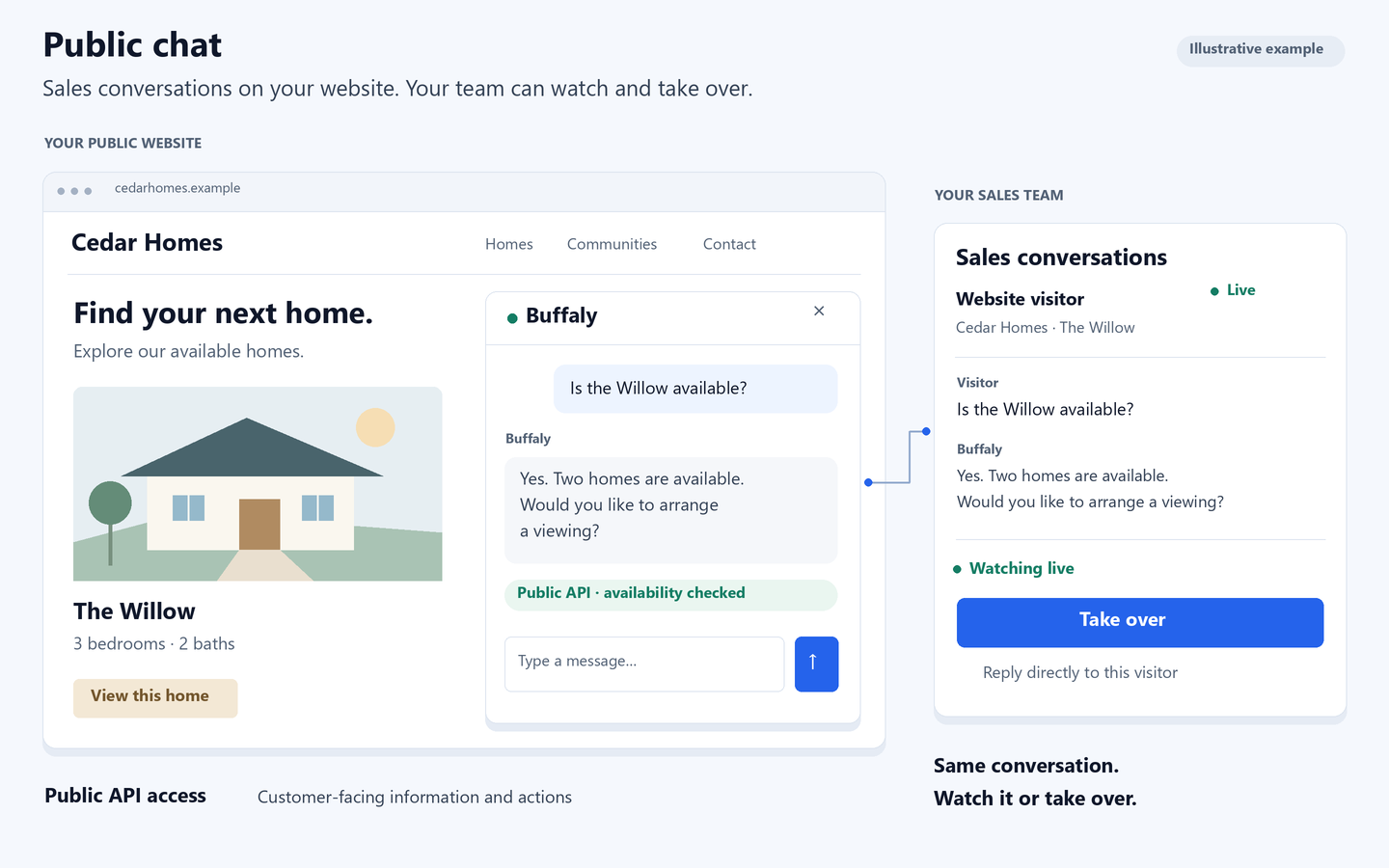
From Discovery to
Executable Code.
This timeline follows a task from contextual problem-solving to a retained reusable skill and then native ProtoScript code. It shows how ad hoc work becomes deterministic execution.
The system internalizes logic and generates its own reusable capability in real time.
Task-specific cost drops from 24,924 to 5,065, a 79.7% reduction in this measured session.
[SemanticProgram.Deterministic]
function CalculateEligibility(Patient p) {
    // Now executing as native code in your VPC
    return p.Scores.Filter(s => s.Value >= 3).Count();
}
11GB of Public Claims
Analyzed Overnight.
This session follows an HHS data export through a custom analysis pipeline that identifies anomalous provider behavior.
15k Patients for
Less than $13.
Buffaly took a real clinical archive, built and ran its own HL7 pipeline during the session, imported 15,075 patient records, and turned the result into a scored, payer-aware opportunity set for downstream action.
- HL7 pipeline built during the session
- 15,075 patient records imported
- Scored, payer-aware output pipeline
HL7 Workflow Snapshot
Continue into the runtime