
Buffaly Logo Buffaly
Open-source AI infrastructure

Own the intelligence your company is building.

Buffaly is an open-source runtime you install on your own machines. It gives LLMs typed memory, real tools, and the ability to turn completed work into software you keep—so the models stay replaceable and the intelligence stays yours.

Install locally Inspect the source Choose your models Keep your knowledge

The durable layer

AI models should be providers, not your operating system.

Models will improve. Prices will change. Providers will come and go. The workflows, tools, history, and judgment your organization develops should not disappear every time you switch a model.

Buffaly sits between replaceable models and your business. The labs provide reasoning. You keep the intelligence that reasoning creates.

The labs want to become your AI platform. Buffaly lets them remain what they should be: replaceable model providers.

What stays when models change

Keep the system. Swap the reasoning provider.

Your ontology, built tools, policies, history, and generated code live in Buffaly. Model access is a replaceable service.

You keep

  • Ontology and typed knowledge
  • Built tools and generated code
  • Session history and decisions
  • Policies and data boundaries

You rent

Token-in, token-out reasoning

- provider: anthropic
+ provider: ollama

Why I released Buffaly

I didn’t want Buffaly to be just another research paper.

Buffaly should not be another abstract claim about neurosymbolic AI. You should be able to install the working system, inspect how it represents knowledge, build tools on it, and decide for yourself where the architecture is strong or weak.

An architecture this consequential should be tested in public, not protected by a demo.

Do not take our word for it

1

Run the actual system

Install Buffaly on infrastructure you control and connect the models you choose.

2

Open the machinery

Inspect the ontology, typed actions, generated tools, and execution paths behind its answers.

3

Try to prove it wrong

Build something difficult. Keep what works. Find the limits without waiting for a vendor’s permission.

Memory you can read

Experience becomes executable structure.

Buffaly can promote successful work into typed knowledge and reusable actions. The result is inspectable, editable, and available to the next agent without reconstructing the entire procedure in a prompt.

Read the technical deep dive
ClaimsDenialAppeal.pts
prototype ClaimsDenialAppeal : OperationalCapability
{
    EntityName = "prepare a denial appeal";
    DependsOn = EligibilityEvidence;
    Produces = AppealPacket;
}

prototype ToPrepareDenialAppeal : TypedAction
{
    Input = DeniedClaim;
    Output = AppealPacket;
    RequiresApproval = true;
}

Five mechanisms, not five slogans

What makes Buffaly a different kind of agent.

Each mechanism takes work that prompt-driven agents perform in text and moves it into inspectable runtime structure your organization can keep.

01

Semantic objects, not notes

Buffaly promotes language into typed entities it can query, reuse, and refine.

What it learns about customers, systems, policies, tools, and exceptions becomes a working model of your organization—not another transcript the next agent must reinterpret.

02

A runtime that builds and keeps tools

Successful repeated reasoning can become a typed action or deterministic implementation.

The tenth occurrence of a workflow can use software instead of asking the model to rediscover the procedure. The capability remains available to every future agent.

03

Your existing code becomes the tool surface

The agent selects a typed action; the runtime calls the real implementation.

No MCP server, CLI wrapper, or hand-built JSON adapter is required when a native boundary already exists.

Buffaly can bind directly to C# methods, .NET objects, DLLs, ProtoScript, databases, files, APIs, and internal services. Your business logic stays native; you do not rebuild your company as AI connectors.

04

Sensitive data stays behind runtime handles

The model can reason over a typed reference without receiving the underlying value.

PHI, credentials, financial records, private objects, and operational state can stay inside the runtime and your native systems. The model chooses the action; trusted code holds the data.

05

Intelligence gets cheaper as it becomes software

Repeated reasoning becomes a tool. Repeated tools become native execution.

You buy the reasoning once and keep the result instead of renting the same reasoning by the token forever.

See the measured 79.7% reduction
Read the technical deep dive

Built for high-trust work

Buffaly started in healthcare because getting it wrong is not an option there.

In healthcare, finance, infrastructure, and other high-consequence operations, a model cannot be the data store, policy engine, and execution environment. Buffaly keeps those responsibilities in a runtime you control.

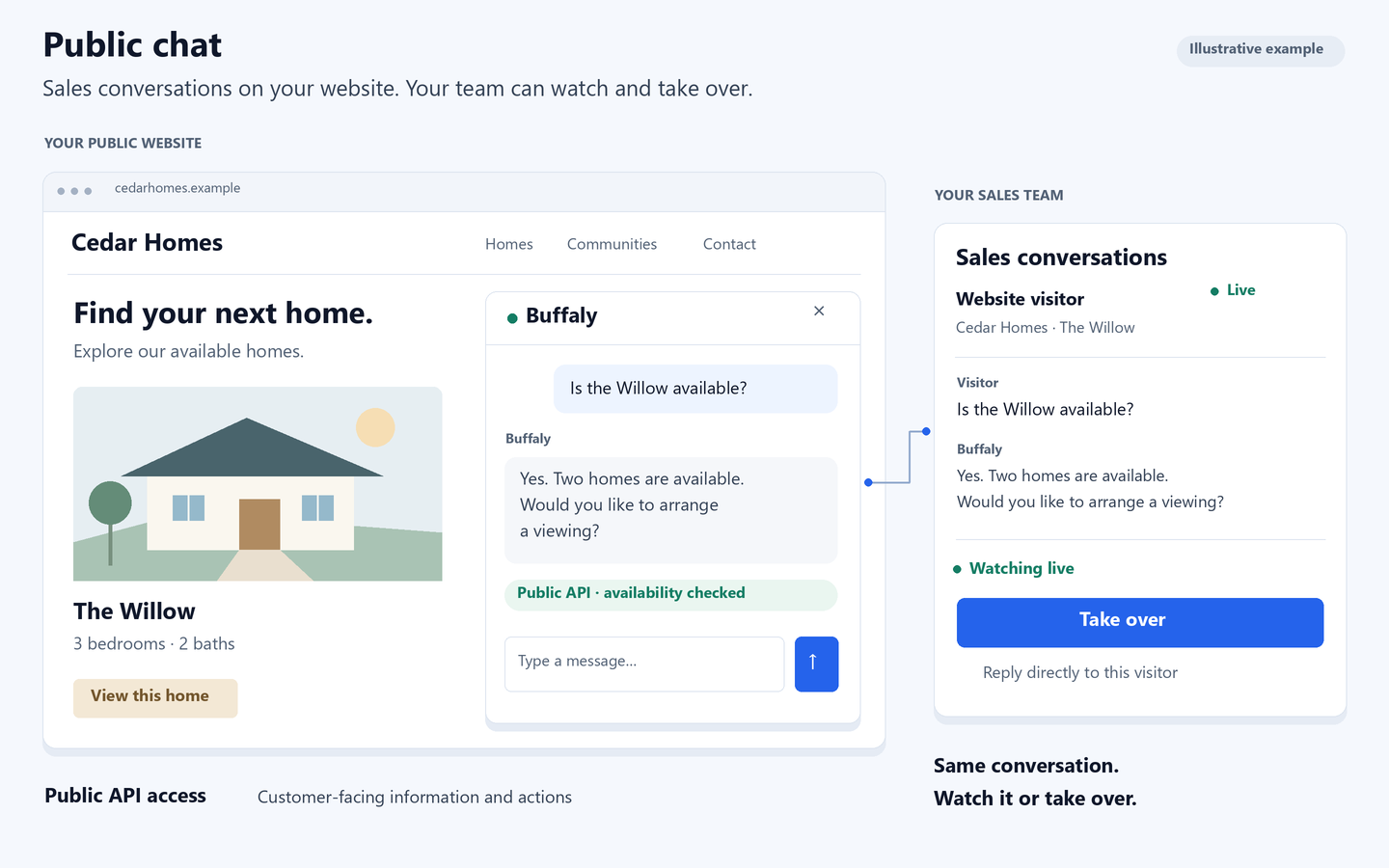
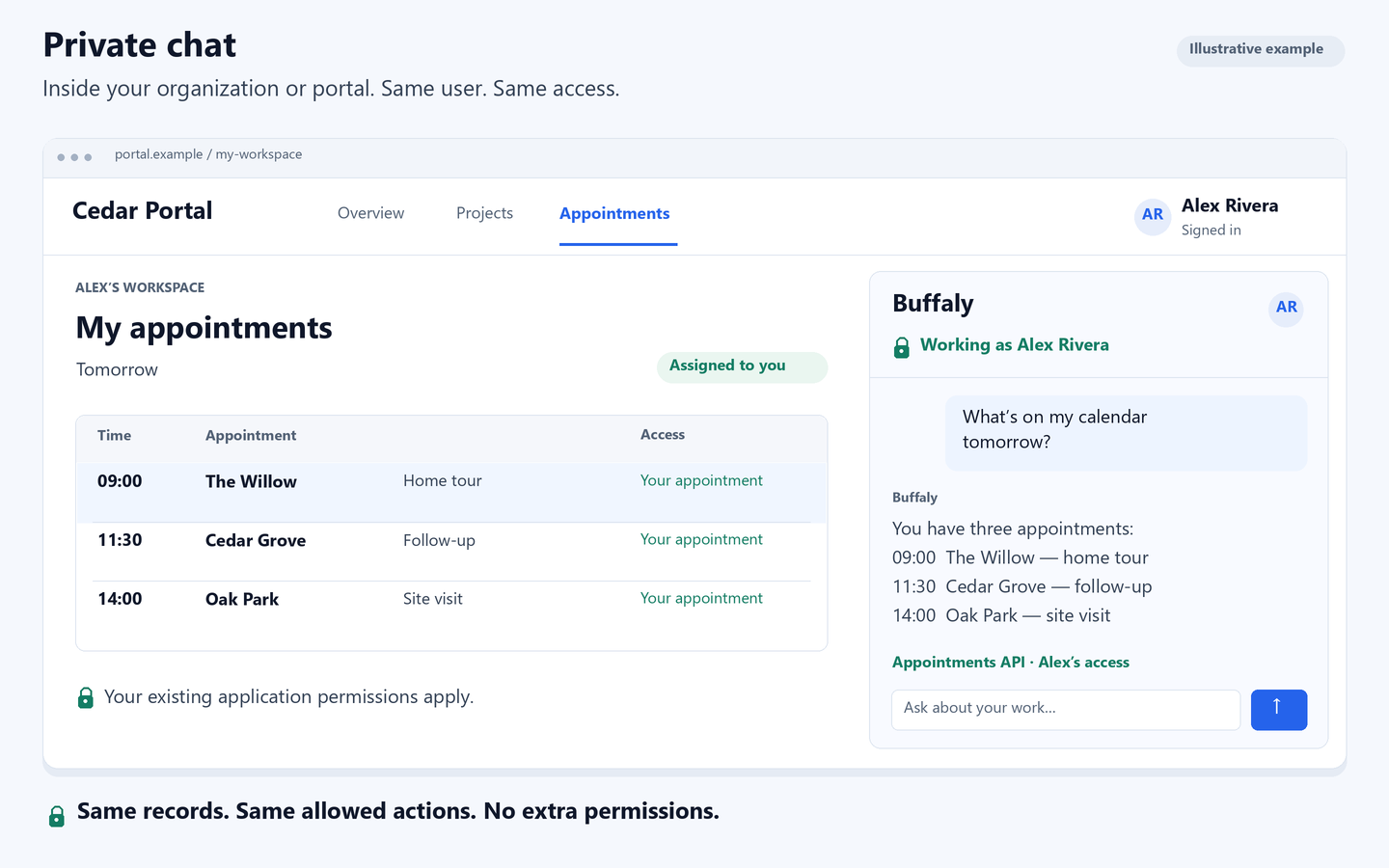
The model can interpret intent and handle ambiguity. Reviewed software still decides what is allowed, touches the real systems, and records what happened.

Deterministic execution

The agent chooses a typed path. Strict, reviewed code performs the operation and validates its result.

Bounded sensitive data

PHI, credentials, and private records can stay behind runtime handles instead of entering model context.

Durable audit

Actions, inputs, decisions, and outcomes produce an execution trace for operational and regulatory review.

Grounded logic

Rules are represented in system contracts, ontologies, schemas, and native business logic—not left for a chatbot to improvise.

The origin story

Buffaly started from a different direction.

It began with a simple observation: children do not learn language from language alone.

I read Goodnight Moon and The Very Hungry Caterpillar to my son so many times that I began trying to reproduce in software what I could watch him doing. He connected words to pictures, objects, actions, routines, emotions, mistakes, and corrections. A word was never just a word. Language attached to something outside itself.

That observation became dual-channel learning: language becomes more tractable when another channel—images, code, data, action, or environment—constrains what matters. Language plus code and language plus data became especially important because the system could test meaning against types, values, operations, and outcomes.

That work led to an interpretable graph substrate for language, meaning, code, data, actions, and memory—and then to ProtoScript, the language for declaring and modifying it. The modern agent runtime is one practical part of that older project. It is why Buffaly does not only remember in text. It remembers in executable structure.

Read Goodnight Moon and the Long Road to Buffaly

Choose your path

Use Buffaly on your terms.

Your infrastructure

Deploy it privately

Run Buffaly in an environment you control, with your own data boundaries, applications, and deployment policies.

Explore deployment options
Expert help

Let us operate it

Bring one difficult workflow. Intelligence Factory can deploy, integrate, and operate Buffaly with you.

Discuss a workflow